



Introduction to One Person Corporation
A One Person Corporation (OPC) is a unique business structure introduced in the Philippines under the Revised Corporation Code of 2019. This innovative legal formation allows a single individual to operate a corporation, which is distinct from both traditional corporations comprising multiple shareholders and sole proprietorships run by an individual without corporate shielding. The OPC enables the owner to enjoy the advantages of incorporation, such as limited liability, while minimizing complexities typically associated with corporate governance.
The legal foundation for OPCs is rooted in the provisions set forth by the Philippine Corporate Code, specifically designed to promote entrepreneurship by allowing individuals to formalize their operations in a corporate capacity. Unlike traditional corporations that require at least five directors, an OPC can function with just one person making all pivotal decisions, establishing a streamlined approach to business management. This structure is particularly appealing for businesses seeking to distinguish their personal assets from the liabilities arising from business operations.
In addition to limited liability protection, OPCs facilitate easier business registration processes, enhancing the overall efficiency of incorporation. This framework permits individuals to engage in essential corporate functions without the need for a nominee director, unless they specifically choose to appoint one for privacy or governance reasons. By allowing full control to a single person while still operating within a formal corporate framework, the One Person Corporation represents a substantial evolution in Philippine business legislation. This model is especially beneficial for entrepreneurs looking to leverage corporate advantages without the burdens that accompany larger corporate structures.
Legal Framework Governing OPCs
The One Person Corporation (OPC) in the Philippines is governed by specific laws and regulations articulated in the Revised Corporation Code of the Philippines (Republic Act No. 11232), which was enacted on February 20, 2019. This law provides a comprehensive legal framework that facilitates the incorporation of a single shareholder entity, thereby addressing the needs of entrepreneurs and small business owners who prefer a simplified corporate structure.
Under the OPC provisions, a single individual can establish a corporation, thereby offering a distinct alternative to traditional sole proprietorships. This incorporation expands legal personality, allowing the owner to protect personal assets from business liabilities. The OPC framework is particularly advantageous as it allows for a more formal business registration process without the need for multiple stockholders.
To successfully register an OPC, compliance with the requirements set forth in the Revised Corporation Code is essential. The incorporation process begins with the submission of the necessary documents to the Securities and Exchange Commission (SEC), including the Articles of Incorporation, which must indicate the intention to operate as an OPC, and a statement declaring the nominee director. Additionally, the OPC must secure a Barangay Business Clearance prior to registration to ensure proper local compliance.
After submission, the SEC will assess the application to confirm that all requirements have been met, which includes an evaluation of the proposed business name. Once approved, the OPC is then issued a Certificate of Incorporation, effectively completing the business registration process. Importantly, the nominee director serves as a safeguard, ensuring that the company adheres to corporate governance norms and complies with regulatory requirements. The provisions under the Revised Corporation Code support the establishment and operation of OPCs, promoting a conducive environment for business growth in the Philippines.
Advantages of Forming an OPC
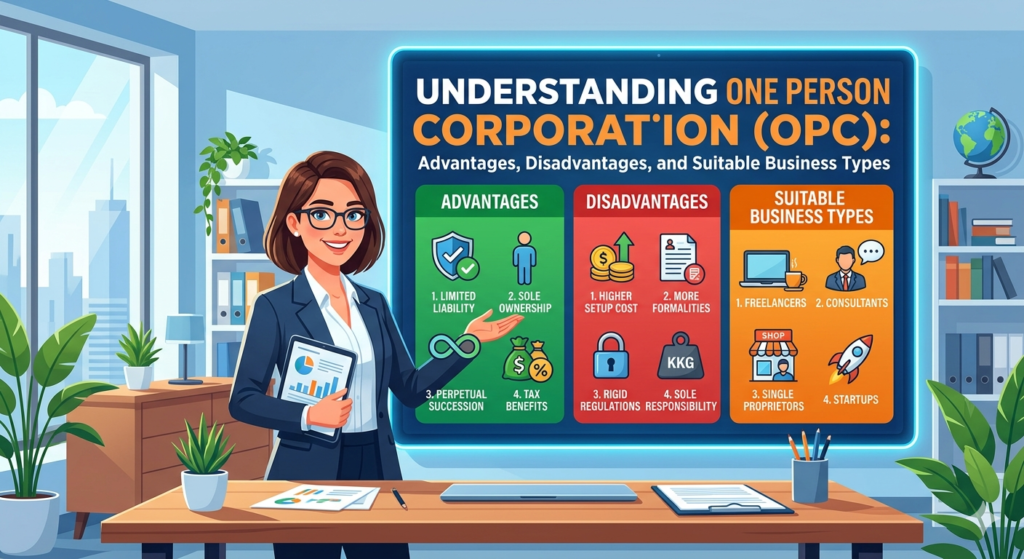
The incorporation of a One Person Corporation (OPC) provides distinct advantages that cater to the needs of entrepreneurs in the Philippines. Among these advantages, the first and foremost is the limited liability benefit. In contrast to sole proprietorships, where personal assets can be at risk for business debts, an OPC shields the owner’s personal assets from corporate liabilities. This means that in case of financial difficulties, the owner’s financial exposure is limited to their investment in the business, protecting personal wealth.
Another significant advantage of forming an OPC is the ease of operation. The regulatory framework for OPCs allows for simplified management procedures as the owner can make decisions swiftly without needing to consult with a board or multiple shareholders. This streamlined process helps in handling daily operations effectively, fostering agile responses to market conditions or internal challenges. The OPC structure is particularly advantageous for business-minded individuals who value operational independence.
Additionally, an OPC enhances credibility with clients and suppliers. Incorporation can lend greater legitimacy to a business, making it more appealing to potential customers and partners. A registered OPC signifies a level of commitment and professionalism that can lead to increased trust from stakeholders. This level of credibility can be particularly beneficial when seeking contracts or establishing long-term relationships, as clients tend to prefer dealing with incorporated entities over informal businesses.
Finally, forming an OPC provides ease in business registration and legal compliance. With a straightforward procedure for incorporation, entrepreneurs can formally establish their business structure relatively quickly. The facilitation of such processes ultimately empowers entrepreneurs to focus on growth and development rather than bureaucratic challenges.
Disadvantages of One Person Corporations
While the concept of a One Person Corporation (OPC) in the Philippines offers a streamlined process for business registration and incorporation, it comes with specific disadvantages that potential business owners must consider. One notable limitation is the restriction on business expansion. OPCs are designed for sole ownership, which can hinder scalability when compared to other corporate structures. As the business grows, the single ownership model may not be able to accommodate increased investments or partnerships, potentially stalling growth opportunities.
Another significant disadvantage relates to compliance requirements. An OPC is required to adhere to stricter regulatory obligations than a sole proprietorship. This includes more complex accounting practices and the necessity of engaging a nominee director, which adds to the operational costs. The need for comprehensive financial reporting can create additional burdens, especially for new entrepreneurs who may not have prior experience in business management.
For example, consider a small tech startup that begins as an OPC. Initially, the owner might find the simplified accounting procedures manageable. However, as the business expands and seeks funding, the complexities of maintaining compliance become apparent. Obtaining financial backing can be challenging due to the perceived risks associated with sole ownership, leading to potential missed opportunities for partnerships or larger contracts that could arise from a more robust corporate structure.
Moreover, the risks associated with sole ownership can also impact business credibility. Some clients and partners may prefer to work with corporations that have multiple stakeholders, viewing them as more stable and reputable. Hence, while the flexibility and autonomy offered by an OPC can be appealing, potential business owners must weigh these benefits against the inherent limitations and challenges that may arise over time.
Suitable Business Types for OPCs
Starting a One Person Corporation (OPC) in the Philippines is a practical option for many entrepreneurs looking to streamline their business operations. With its unique structure, OPCs offer the benefit of limited liability while simplifying governance as it allows for a single shareholder. This form of incorporation is particularly advantageous for various sectors, allowing business registration for both individuals and small enterprises.
One of the most suitable business types for OPCs is in the technology sector. As technology continues to evolve rapidly, entrepreneurs are often led to establish their own firms to develop innovative solutions or applications. An OPC setup provides the technology startup adequate support while ensuring the owner retains control over decision-making processes. Moreover, the limited liability aspect protects the owner’s personal assets from operational risks.
Another promising sector for OPC registration is professional services. Many service-oriented businesses, such as consultancy firms, legal practices, or accounting services, benefit from the OPC structure. This arrangement allows an individual professional to register and incorporate their practice without needing partners. Therefore, the simplicity of accounting and regulatory compliance becomes a distinct advantage.
Additionally, creative industries such as arts, media, or entertainment also find OPCs beneficial. An individual artist, writer, or videographer can establish an OPC, protecting their creativity while allowing them to manage income more effectively. This promotes a clear identification of the brand, making it easier to attract clients and collaborators.
Ultimately, the flexibility offered by OPCs allows entrepreneurs to explore various industries without the pressing need for partnerships, making it an appealing route for many aspiring business owners. The ability to hire a nominee director, if necessary, further enhances its practicality, presenting options that suit different business needs.
OPC vs. Sole Proprietorship vs. Traditional Corporation
Understanding the differences between a One Person Corporation (OPC), a sole proprietorship, and a traditional corporation is essential for prospective business owners in the Philippines. Each type of business entity has unique features, advantages, and limitations, which can significantly impact a business’s registration process, taxation, liability, and overall management structure.
A sole proprietorship is the simplest form of business, where one individual owns and operates the business. This structure does not require formal registration with the Securities and Exchange Commission (SEC), thereby making it easy and relatively inexpensive to set up. However, the sole proprietor is personally liable for all debts and obligations incurred by the business. This means that an individual’s personal assets could be at risk in the event of business liabilities. Taxation for sole proprietorships is straightforward, as the income is reported directly on the owner’s personal tax return.
On the other hand, a traditional corporation, consisting of multiple shareholders, provides limited liability protection to its owners. This structure requires registration with the SEC and entails a more complex procedure, including the submission of Articles of Incorporation, bylaws, and compliance with corporate governance rules. While a broader capital base can be achieved through multiple shareholders in a traditional corporation, it may involve double taxation—once at the corporate level and again at the individual level when profits are distributed as dividends.
Meanwhile, an OPC caters to businesspersons seeking the benefits of a corporate structure while being the sole owner. Like a traditional corporation, an OPC offers limited liability protection, but it can be registered with just one individual. This means the owner can enjoy the advantages of incorporation without needing partners or a board of directors. In terms of taxation, an OPC is treated similarly to regular corporations, but it does not face double taxation as seen in traditional corporations.
When choosing between these entities, business owners should consider factors such as liability, taxation, and the scale of operations. The decision hinges on personal circumstances, the nature of the business, and long-term objectives within the Philippine business landscape.
Setting Up Your OPC: A Step-by-Step Guide
Establishing a One Person Corporation (OPC) in the Philippines is a systematic process, which involves several essential steps to ensure compliance with the prevailing regulations. First, it is crucial to decide on a unique corporate name for your business. This name must be verified through the Securities and Exchange Commission (SEC) to guarantee its availability and adherence to relevant naming conventions.
The next phase entails preparing the required documentation, which includes the Articles of Incorporation and By-Laws. The Articles of Incorporation should specify the details of the OPC, including the business purpose, office address, and the appointment of a nominee director. It is imperative to note that the nominee director serves as an essential figure in maintaining transparency and legal compliance.
Once your documents are ready, you will need to submit them alongside the initial registration fee to the SEC. The processing time for the registration of your OPC typically ranges from three to five working days, contingent on the completeness of your documentation. Upon approval, you will receive a Certificate of Incorporation, which legitimizes your business entity.
Furthermore, you should secure a Tax Identification Number (TIN) from the Bureau of Internal Revenue (BIR) shortly after incorporation. This step is crucial for tax purposes and involves filling out a BIR Form 1901. Following this, you will be required to register for the necessary permits and licenses specific to your industry, ensuring that your OPC operates legally within its designated jurisdiction.
In summary, setting up your OPC entails a series of well-defined steps that require attention to detail and timely execution. Navigating through business registration, documentation preparation, and compliance with government regulations, sets a solid foundation for your One Person Corporation to thrive in the competitive market.
Expert Guidance from 25east in Establishing Your OPC
Establishing a One Person Corporation (OPC) in the Philippines can be a complex process, but 25east offers specialized services to guide entrepreneurs through each step. As an expert in business registration and incorporation, 25east harnesses its extensive industry knowledge to simplify the OPC formation process. Our experienced team assists in understanding the legal requirements, ensuring compliance with relevant regulations, and fulfilling all necessary documentation.
One of the primary benefits of working with 25east is the comprehensive support we provide. From the initial consultation, we assess the specific needs and objectives of each entrepreneur, tailoring our services to create a bespoke approach to OPC establishment. Whether it entails acting as a nominee director or managing the intricate details of the incorporation process, our professionals aim to alleviate the burdens associated with starting a new business.
Moreover, 25east ensures that clients are well-informed about the obligations and responsibilities tied to operating an OPC. We emphasize the importance of adhering to accounting practices and regulatory compliance, helping clients maintain good standing in the eyes of the law. This commitment extends to post-incorporation support, where we offer ongoing resources to sustain your business operations efficiently.
Leveraging our expert guidance, entrepreneurs can confidently navigate the intricacies of OPC formation. Our focus on customer satisfaction reflects our dedication to becoming a trusted partner in your business journey. Choosing 25east means opting for a hassle-free experience that focuses on your entrepreneurial aspirations while ensuring that all processes related to your OPC are thoroughly managed and executed correctly.
Conclusion and Key Takeaways
In conclusion, understanding the nuances of a One Person Corporation (OPC) in the Philippines is crucial for prospective business owners. An OPC allows individuals to establish a business entity with a single owner while enjoying the benefits of limited liability protection. This structure is particularly appealing due to its simplicity in management and the empowerment it offers entrepreneurs, enabling them to operate with autonomy.
From our discussion, we noted that registration and incorporation processes for an OPC are straightforward, provided you have the right guidance and resources. Employing services like those offered by 25east can significantly simplify the business registration process. Their expertise in accounting and incorporation can assist individuals in navigating the legal requirements and ensuring compliance, ultimately leading to a smoother setup experience.
Furthermore, the role of nominee directors cannot be understated in the realm of OPCs. Nominee directors help maintain corporate governance and ensure legal compliance, making them an invaluable resource for single owners who may lack extensive business experience. The collaboration with experts at 25east can particularly enhance your understanding and application of these essential elements in your business journey.
Ultimately, forming an OPC is an empowering step towards entrepreneurial independence and financial growth. By leveraging professional resources and acquiring a comprehensive understanding of the intricacies involved, potential business owners can confidently embark on their enterprise while significantly mitigating risks. For those considering this path, 25east stands ready to assist in establishing a successful OPC, ensuring adherence to required legal frameworks while allowing you to concentrate on growing your business.