First off, congratulations! Exceeding the ₱3,000,000 mark in the middle of the year means your business is growing and doing incredibly well. However, it is totally understandable to feel a bit overwhelmed right now because it also means your tax obligations are about to change.
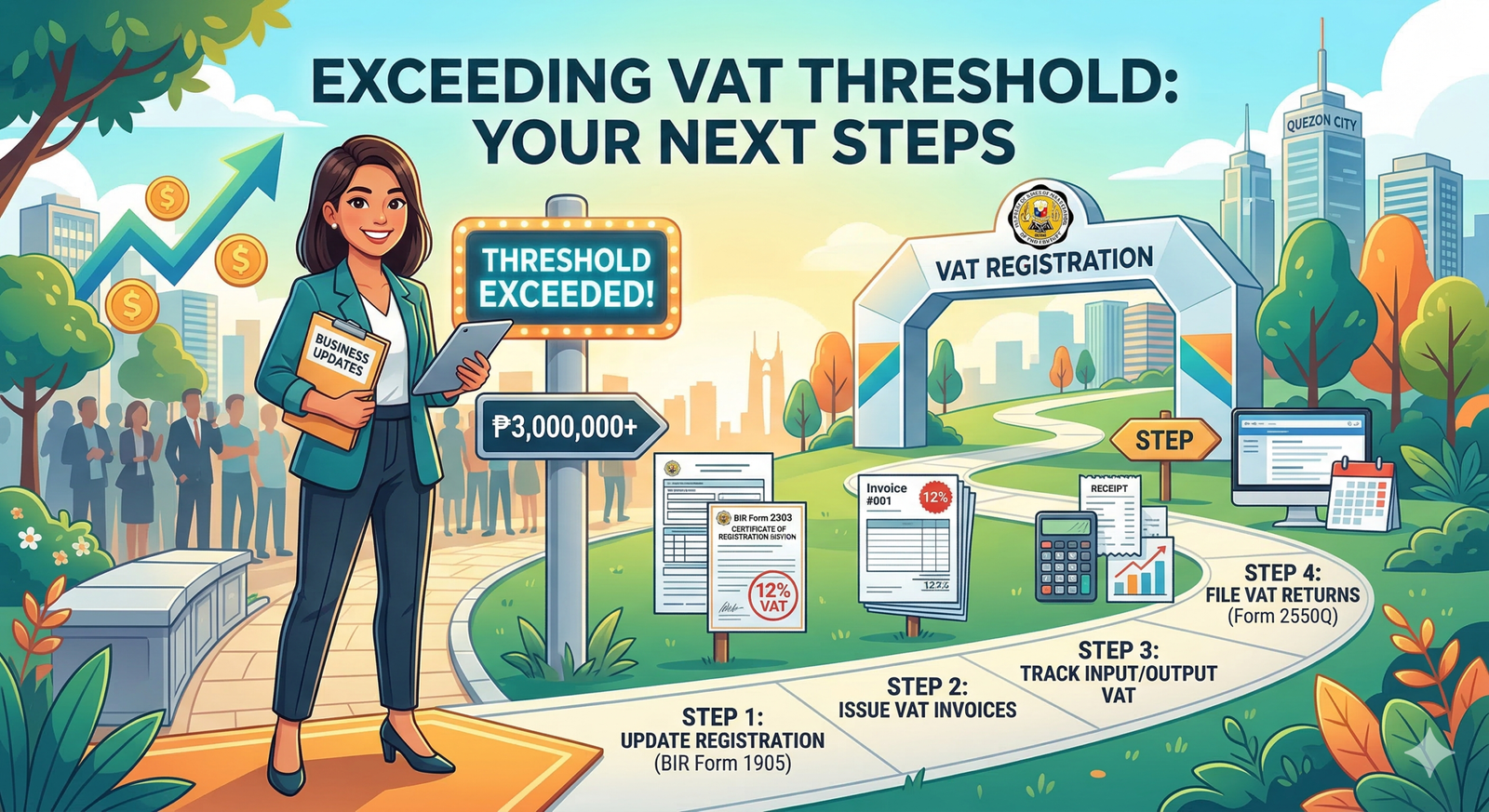
Under the rules of the Bureau of Internal Revenue (BIR), once your gross sales or receipts exceed ₱3,000,000 within a 12-month period, you automatically lose your Non-VAT exemption. You are now legally required to update your registration from Non-VAT to VAT. Here is exactly what you need to do, grounded in current BIR regulations.
1. Know Your Deadline
You must update your registration not later than the last day of the month following the month you exceeded the threshold. > Example: If your gross sales hit ₱3,000,001 on July 15th, you have until August 31st to update your registration to VAT.
2. The Step-by-Step Update Process
You will need to visit your Revenue District Office (RDO) to process this transition.
-
Submit BIR Form 1905: Fill out the Application for Registration Information Update (Form 1905) to change your tax type from Percentage Tax (Non-VAT) to Value-Added Tax.
-
Get a New Certificate of Registration (COR): The BIR will issue you a new BIR Form 2303 (COR) reflecting your new status as a VAT-registered taxpayer.
-
Apply for New VAT Invoices: Because of the recent Ease of Paying Taxes (EOPT) Act, the primary document for both goods and services is now the Invoice. You must apply for a new Authority to Print (ATP) to print VAT Invoices.
-
Surrender Old Receipts: You will be required to surrender your unused Non-VAT invoices/receipts for cancellation by the BIR so you don’t accidentally issue them once you are VAT-registered.
3. What Happens If You Don’t Update?
It is crucial not to ignore this. If the BIR discovers you exceeded the threshold and failed to register for VAT:
-
You will be held liable to pay the 12% Output VAT on all your sales from the moment you exceeded the threshold.
-
The Catch: Because you were not properly registered, you will not be allowed to claim any Input VAT (the VAT you paid on your purchases) to lower your tax due.
-
You will also face surcharges, interest, and penalties for late registration and non-filing of VAT returns.
4. Important Financial Adjustments
-
Pricing: You will now need to factor the 12% VAT into your selling price (or charge it on top of your current prices).
-
Transitional Input VAT: Ask your accountant about claiming a “Transitional Input Tax.” When you transition to VAT, you are generally allowed to claim a 2% input tax on your beginning inventory of goods, materials, and supplies, which can help lower your first VAT payable.
-
Filing Returns: You will stop filing the Quarterly Percentage Tax (Form 2551Q) and will start filing the Quarterly VAT Return (Form 2550Q).
Transitioning to VAT
Transitioning to VAT can feel like learning a new language at first, but once you grasp the relationship between Input VAT and Output VAT, it makes perfect sense.
At its core, Value-Added Tax (VAT) is designed so that the final consumer pays the tax, but the businesses along the way act as the collection agents for the government.
Here is how the mechanics work:
1. Output VAT (What you collect)
This is the 12% tax you add to the selling price of your goods or services. Because you are now VAT-registered, you must charge this to your customers.
-
Think of it as: Money you are holding in trust for the BIR. It is not your income.
2. Input VAT (What you pay)
This is the 12% tax you are charged when you purchase goods, raw materials, or services from other VAT-registered businesses for your operations.
-
Think of it as: A tax credit or a discount coupon you can use against what you owe the BIR.
3. The Computation
The formula to compute what you actually have to pay the BIR is straightforward:
Output VAT – Input VAT = VAT Payable
If your Output VAT is higher than your Input VAT, you pay the difference to the BIR. If your Input VAT is higher (meaning you bought more than you sold that month), you don’t pay any VAT, and the excess “credit” carries over to the next billing period.
Let’s Look at a Real-World Example
Imagine you run a furniture manufacturing business.
Step 1: Your Purchases (Generating Input VAT) You buy wood, paint, and tools from a VAT-registered hardware store. The base price of the materials is ₱100,000.
-
The hardware store adds 12% VAT: ₱12,000.
-
You pay them a total of: ₱112,000.
-
Your Input VAT credit is: ₱12,000.
Step 2: Your Sales (Generating Output VAT) You turn those materials into beautiful dining tables and sell them to a customer. The base price you set for the tables is ₱150,000.
-
You must add 12% VAT to your price: ₱18,000.
-
The customer pays you a total of: ₱168,000.
-
Your Output VAT is: ₱18,000.
Step 3: Paying the BIR At the end of the quarter, you calculate what you owe:
-
Output VAT Collected: ₱18,000
-
Less: Input VAT Paid: ₱12,000
-
Total VAT Payable to BIR: ₱6,000
The Golden Rule: Receipts are Everything
You can only claim Input VAT if you have a valid, BIR-compliant VAT Invoice from your supplier. If you buy from a Non-VAT supplier, or if you lose the invoice, you cannot claim that purchase as an Input VAT credit, which means your VAT Payable will be higher.
The Silver Lining: When you were Non-VAT, the VAT you paid to your suppliers was just an unrecoverable business expense. Now that you are VAT-registered, every valid VAT purchase you make actively reduces your tax bill.