 If you are running a small business in the Philippines—whether it’s a neighborhood bakery, a local handicraft shop, or an online retail store—every peso counts. To help small businesses survive and thrive, the government enacted the Barangay Micro Business Enterprise (BMBE) Law (Republic Act No. 9178).
Despite the massive benefits this law offers, thousands of eligible micro-entrepreneurs operate without taking advantage of it simply because they don’t know it exists or assume the process is too complex.
Here is your straightforward, no-nonsense guide to what a BMBE is, why you should register, and exactly how to secure your tax exemptions.
What Exactly is a BMBE?
A Barangay Micro Business Enterprise (BMBE) is any business entity or enterprise engaged in the production, processing, or manufacturing of products, including agro-processing, trading, and services.
Think of it as a special legal status granted to micro-businesses to act as a “seedbed” for Filipino entrepreneurial talent. By reducing the regulatory and financial burden on these small ventures, the government hopes they will eventually grow into larger, job-creating enterprises.
The “Big Three” Benefits: Why You Should Care
Registering as a BMBE unlocks some of the most powerful legal and financial incentives available to small businesses in the country:
-
Income Tax Exemption: This is the biggest draw. A registered BMBE is 100% exempt from paying income tax on income arising directly from its business operations. This allows you to reinvest your profits directly back into growing your business.
-
Exemption from the Minimum Wage Law: BMBEs are legally allowed to pay their employees below the statutory regional minimum wage. This gives micro-businesses the flexibility to hire staff even when operating on razor-thin margins. (Note: You must still provide your employees with mandatory statutory benefits like SSS, PhilHealth, and Pag-IBIG).
-
Priority Access to Credit & Training: Government financial institutions (like LandBank, DBP, and SB Corp) are mandated to set up special credit windows for BMBEs. Additionally, you get priority access to technology transfer, management training, and marketing assistance from agencies like the DTI, DOST, and TESDA.
Do You Qualify? The BMBE Eligibility Checklist
To qualify for BMBE status, your business must tick the following boxes:
-
Asset Limit: Your total business assets must not exceed ₱3,000,000.00. This includes cash, equipment, inventory, and assets arising from loans. Importantly, the value of the land where your business office, plant, or equipment is situated is excluded from this ₱3 Million limit.
-
Business Activity: You must be engaged in production, processing, manufacturing, trading, or services.
-
The “Professional” Exception: Businesses that render services in connection with the exercise of a licensed profession (e.g., accounting firms run by CPAs, legal clinics run by doctors) are disqualified from becoming BMBEs.
-
Not a Branch: Your business cannot be a branch, subsidiary, or division of a large-scale enterprise.
Step 1: Getting Your BMBE Certificate
Thanks to the Go Negosyo Act, BMBE registration is handled by the Department of Trade and Industry (DTI), making the process standardized and completely free of charge.
-
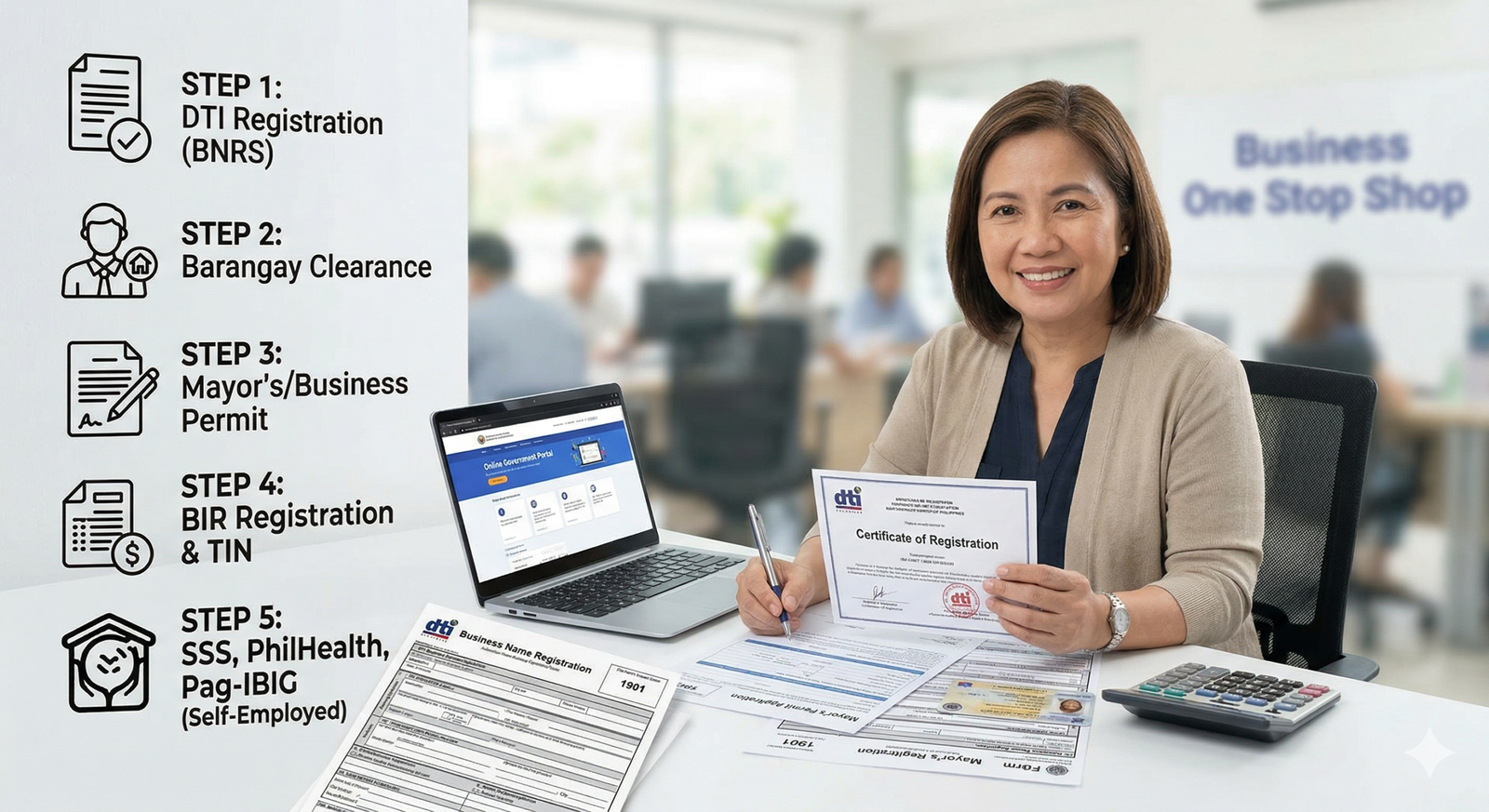
Get your Primary Business Registration: You need your base registration first (DTI for Sole Proprietors, SEC for Corporations/Partnerships, CDA for Cooperatives).
-
Submit the Application: Go to your nearest DTI Negosyo Center with a filled-out BMBE Application Form (Form 01) and your primary registration certificate. You can also apply online via the DTI’s official BMBE portal (
bmbe.dti.gov.ph). -
Receive Your Certificate: If all documents are in order, the DTI will issue your BMBE Certificate of Authority within 15 working days. This is valid for two (2) years and is renewable.
Step 2: The Crucial Catch—Registering with the BIR
Many entrepreneurs get their DTI BMBE Certificate, hang it on their wall, and assume they are automatically exempt from taxes. This is a dangerous misconception.
To actually avail of the income tax exemption, you must register your BMBE status with the Bureau of Internal Revenue (BIR) at your designated Revenue District Office (RDO). The requirements differ slightly depending on whether you are registering a brand new business or updating an existing one.
A. For NEW Businesses Registering with the BIR
If you are registering your business with the BIR for the very first time, you will apply for your BMBE tax exemption alongside your initial registration.
| Requirement | Description |
| BIR Form 1901 or 1903 | Use Form 1901 for Sole Proprietors, or Form 1903 for Corporations/Partnerships. Submit two (2) original copies. |
| BMBE Certificate of Authority | 1 photocopy of the certificate issued to you by the DTI. |
| Primary Registration | 1 photocopy of your DTI, SEC, or CDA Certificate. |
| Valid ID | 1 photocopy of any government-issued ID of the applicant. |
| Sample Invoices/Receipts | A clear sample of your proposed receipts/invoices (or buy BIR Printed Invoices at the counter). |
B. For EXISTING Businesses Updating their Tax Status
If you already have a BIR Certificate of Registration (COR) and just recently acquired your BMBE Certificate, you need to update your tax profile to reflect the income tax exemption.
| Requirement | Description |
| BIR Form 1905 | The Application for Registration Information Update. Submit two (2) original copies. Check the box for “Update of Tax Type/Details.” |
| Original BIR Form 2303 | You must surrender your current original Certificate of Registration (COR). The BIR will print you a new one that explicitly reflects your BMBE-exempt status. |
| BMBE Certificate of Authority | 1 certified true copy / photocopy of the certificate from the DTI. |
| Sworn Statement of Assets | A notarized document declaring your business assets (excluding land) to prove you are still under the ₱3 Million limit. |
Note: Thanks to the recent Ease of Paying Taxes (EOPT) Act (RA 11976), the BIR officially removed the ₱500 Annual Registration Fee starting in 2024. You no longer need to pay this when registering or updating!
Essential Tax Reminders for BMBEs
Before you celebrate your new tax-free status, keep these crucial realities in mind so you don’t run into trouble with the BIR later:
-
You Still Have to File: Being exempt from paying income tax does not exempt you from filing your Income Tax Returns (ITR). You must still file your annual and quarterly ITRs (declaring your BMBE-exempt income) to maintain a clean record.
-
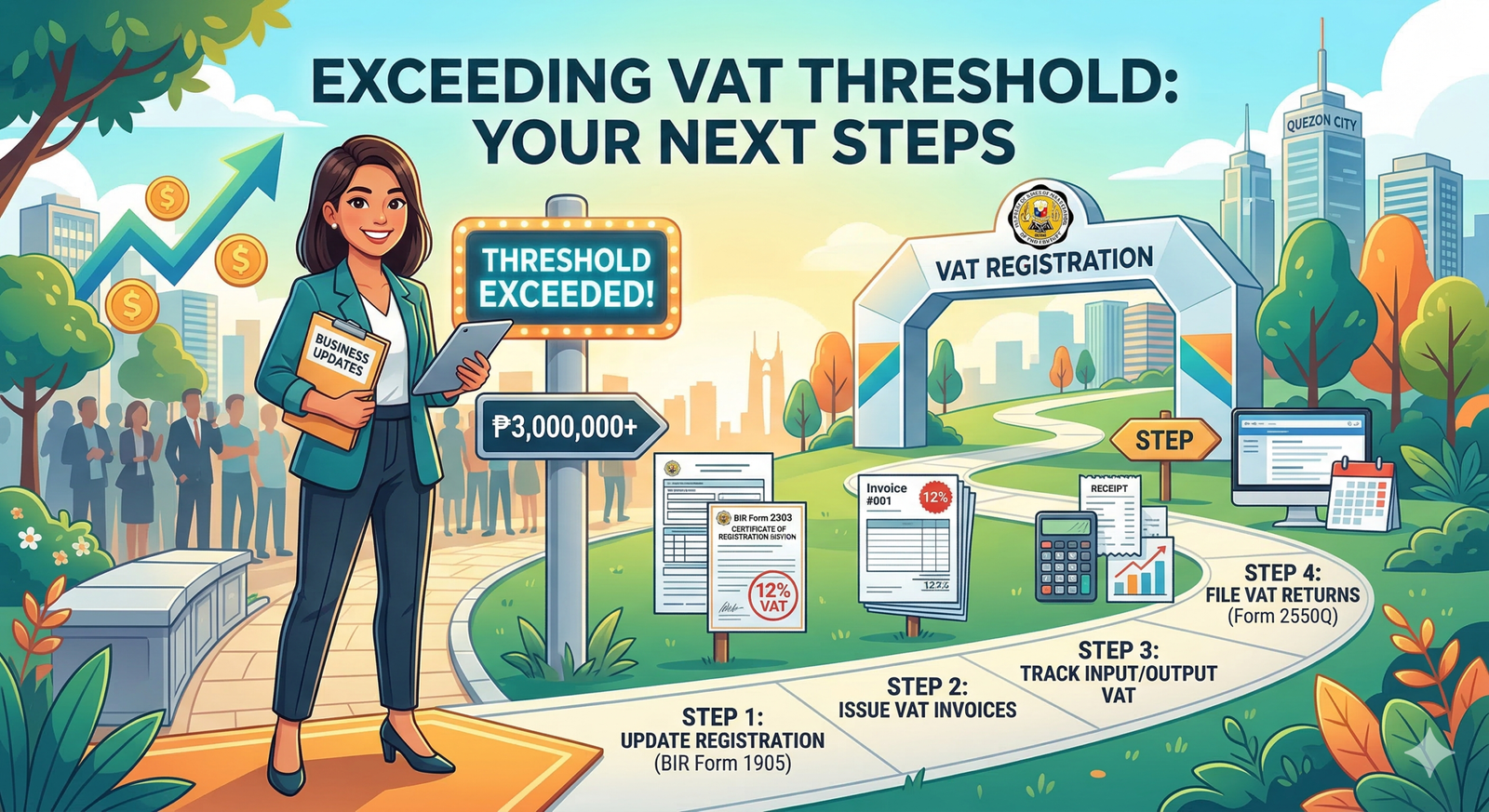
Other Taxes Still Apply: BMBE only covers Income Tax. You are still liable to pay Percentage Tax (or VAT, if applicable), Withholding Taxes for your employees or rent, and your Local Mayor’s/Business Permit fees.
-
Issue Receipts: You are legally required to issue official receipts or sales invoices for your transactions, regardless of your BMBE status.